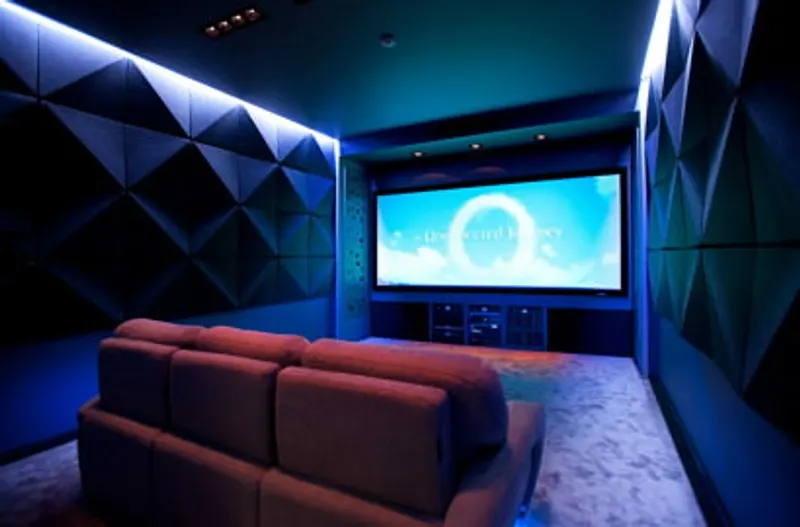
Stretch ceilings offer a simple technological solution for creating acoustic comfort in a room without compromising its appearance. Acoustic treatment consists of fine perforation of the PVC film: the holes have very small diameters, from 0.1 mm to 1 mm, making them practically invisible. Perforation can be applied to any ceiling, regardless of its colour or printed image. Even a customised ceiling can therefore provide sound insulation.
The effectiveness of sound-wave absorption is determined by the following features:
- The diameter of the perforations.
- The spacing between the perforations.
- The thickness of the PVC film.
- The distance between the original ceiling and the suspended ceiling — the plenum. Additional sound-absorbing material can be placed in this space to improve the performance of the entire insulation system.
The acoustic adaptation of a room achieves its best performance through the following effects:
- The membrane effect, caused by the elasticity of the PVC film, produces resonance in the volume of air between the ceilings and absorption of low frequencies.
- The number and size of the perforations affect the mid-frequency range.
- The thickness and density of the insulating film affect the absorption of high-frequency waves.
Acoustic stretch ceilings are generally installed in public spaces with high noise levels, such as shopping centres, sports halls and clubs, but they are also welcome in apartments with home cinema systems.